Easy Flan Recipe with Silky Caramel Custard That Slices Clean
A good flan wobbles like gelatin, slices like soft butter, and sends caramel running down the side of the plate. Most home versions get one of those right. I wanted all three, so I tested this recipe nine times over four weeks, changing one thing per batch: oven temperature, pan size, mixing method, and chill time.
The winner is a creamy dessert built on sweetened condensed milk, evaporated milk, and five whole eggs, baked at a gentle 325°F in a water bath. The custard comes out silky with no holes, and the caramel melts into sauce while it chills.
I started testing because my sister wanted a birthday dessert she could make two days ahead. My first batch, whipped in a blender, looked like Swiss cheese. Flan fit her plan, and it takes only seven ingredients plus water, so if you can melt sugar and whisk eggs, you can make this one.
Here is why this version works.
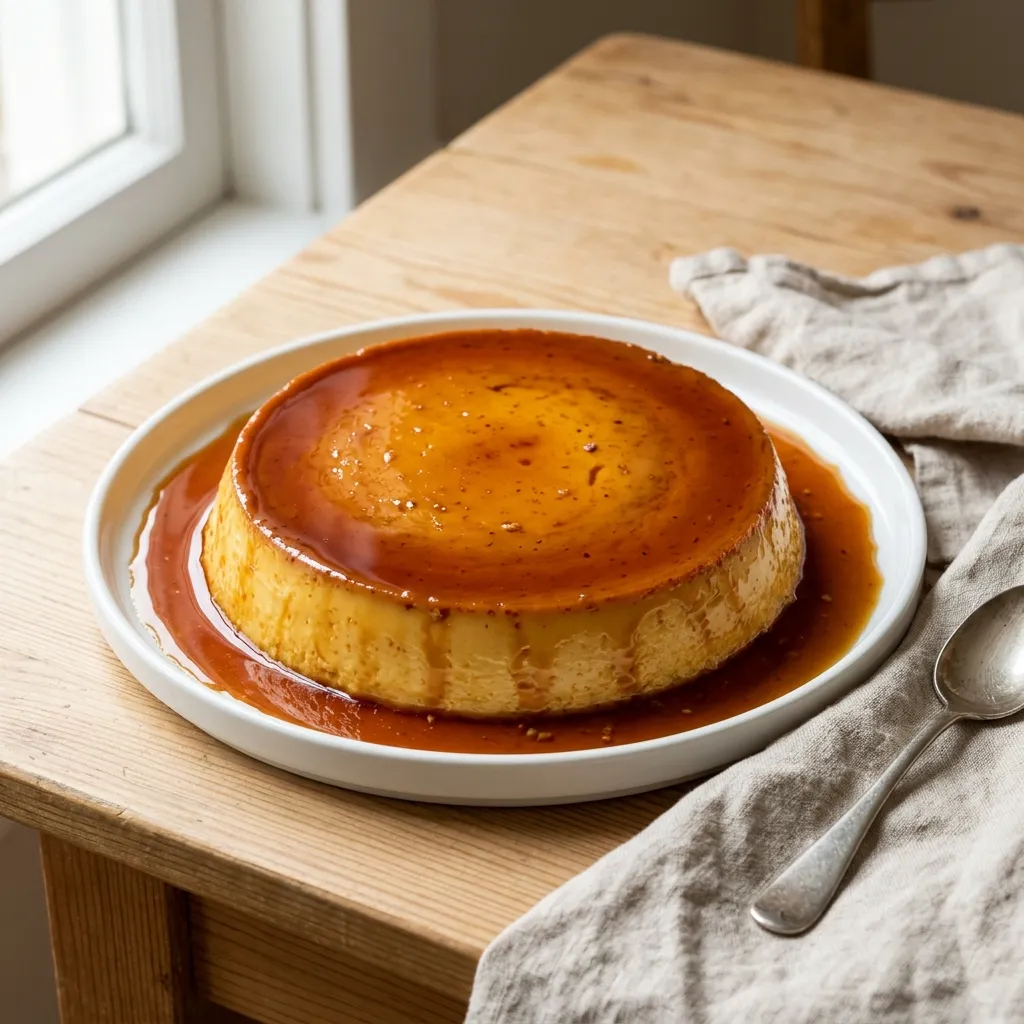
Table of Contents
Why You Will Love This Flan Recipe
- Hands-on time is 15 minutes, and the oven handles the rest.
- The custard is dense and smooth, never spongy, because you whisk by hand and strain before baking.
- Most of the ingredients are pantry staples, so there is no special store run.
- It improves overnight. The caramel turns into sauce and the custard firms enough for clean slices.
- One 9-inch pan serves eight, which suits school nights and weekend company alike.
Recipe Snapshot
- Prep Time: 15 minutes
- Cook Time: 1 hour 15 minutes
- Total Time: 8 hours 30 minutes, including 1 hour of cooling and 6 hours of chilling
- Servings: 8
- Difficulty: Medium
- Calories per Serving: About 390
- Key Ingredient or Tool: 9-inch round cake pan
- Best For: Make-ahead dinners and birthdays
Nutrition Information
- Calories per Serving: About 390
- Protein: 12 g
- Carbs: 59 g
- Fat: 12 g
- Fiber: 0 g
- Sugar: 59 g
- Sodium: 244 mg
- Serving Size: About 1 slice (one eighth of the pan)
- Servings per Recipe: 8
Each slice gives you about 12 grams of protein from the eggs and milks, which makes it more filling than most desserts. It has no fiber and plenty of sugar, so this flan is a treat to share, not an everyday dessert.
Nutrition values are approximate and calculated per serving using standard ingredient amounts. Values may vary based on brands used and portion sizes.
Ingredients
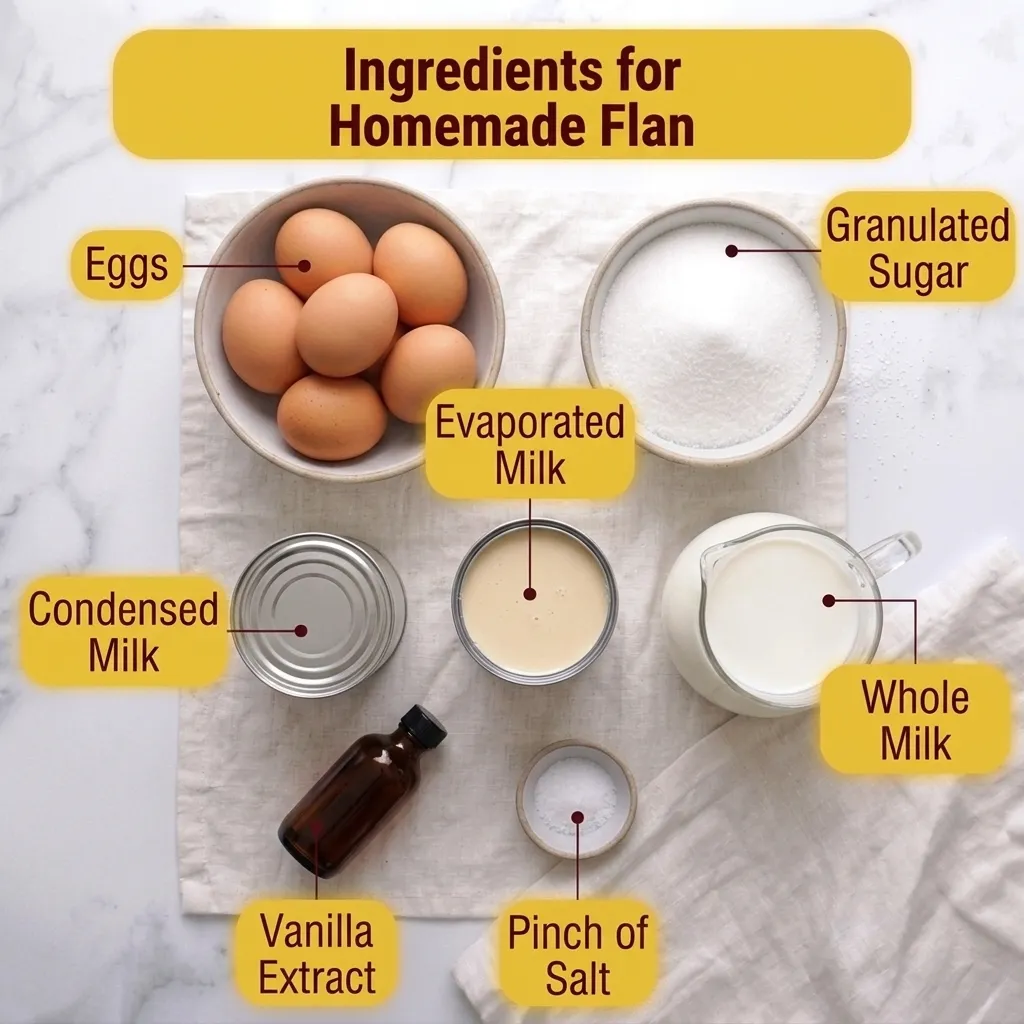
For the Caramel
- 1 cup granulated sugar (cane sugar works the same)
- 1/4 cup water
For the Custard
- 5 large eggs, at room temperature (no substitute works here)
- 1 can (14 ounces) sweetened condensed milk (no one-to-one swap exists)
- 1 can (12 ounces) evaporated milk (whole milk makes a lighter custard)
- 1 cup whole milk (2% milk sets a little softer)
- 1 tablespoon alcohol-free vanilla extract (or the seeds from 1 vanilla bean)
- 1/4 teaspoon fine sea salt (or 1/2 teaspoon Diamond Crystal kosher salt)
- About 6 cups hot water, for the water bath
Three ingredients decide the result. Eggs do the structural work: five whole eggs hold a clean slice without turning rubbery, while extra yolks make it richer but looser.
Sweetened condensed milk supplies the sweetness and the thick, silky body. I used La Lechera in every test so the thickness never changed.
Vanilla is the only flavoring, so use a good one. Alcohol-free extract and fresh vanilla bean seeds both taste clean and strong.
Equipment Needed
- 9-inch round cake pan, 2 inches deep: Straight, smooth sides help the flan slide out whole.
- Roasting pan, at least 12 by 14 inches: Water must reach halfway up the cake pan inside it.
- Heavy medium saucepan: A light interior shows the caramel color.
- Fine-mesh strainer: It catches egg threads and pops bubbles.
- Hand whisk: It keeps foam low, unlike a blender.
Preparation
- Set an oven rack in the center and heat the oven to 325°F.
- Take the eggs out of the fridge 30 minutes ahead so they blend without streaks.
- Measure everything before lighting the burner, because caramel goes from pale to burnt in under a minute.
- Leave the cake pan dry and ungreased, since the caramel does the nonstick work.
Pro Tip: Boil 6 cups of water in a kettle before you start the caramel. Hot water keeps the bath temperature steady, while cold water slows the bake and cooks the edges unevenly.
Step-by-Step Instructions
- Stir the sugar and water in the saucepan over medium heat until the sugar dissolves, then stop stirring. Chef’s Note: Swirl the pan if one side darkens faster, because a spoon can start crystals. After 8 to 10 minutes the syrup should look like an old copper penny.
- Pour the hot caramel into the dry cake pan and tilt to coat the bottom within 30 seconds. The caramel should stop moving and look glossy amber.
- Whisk the eggs for 30 seconds, then add the condensed milk, evaporated milk, whole milk, vanilla, and salt. Chef’s Note: Keep the whisk low, because beaten-in air turns into holes later. After 1 minute the mixture should look smooth, pale yellow, and nearly foam free.
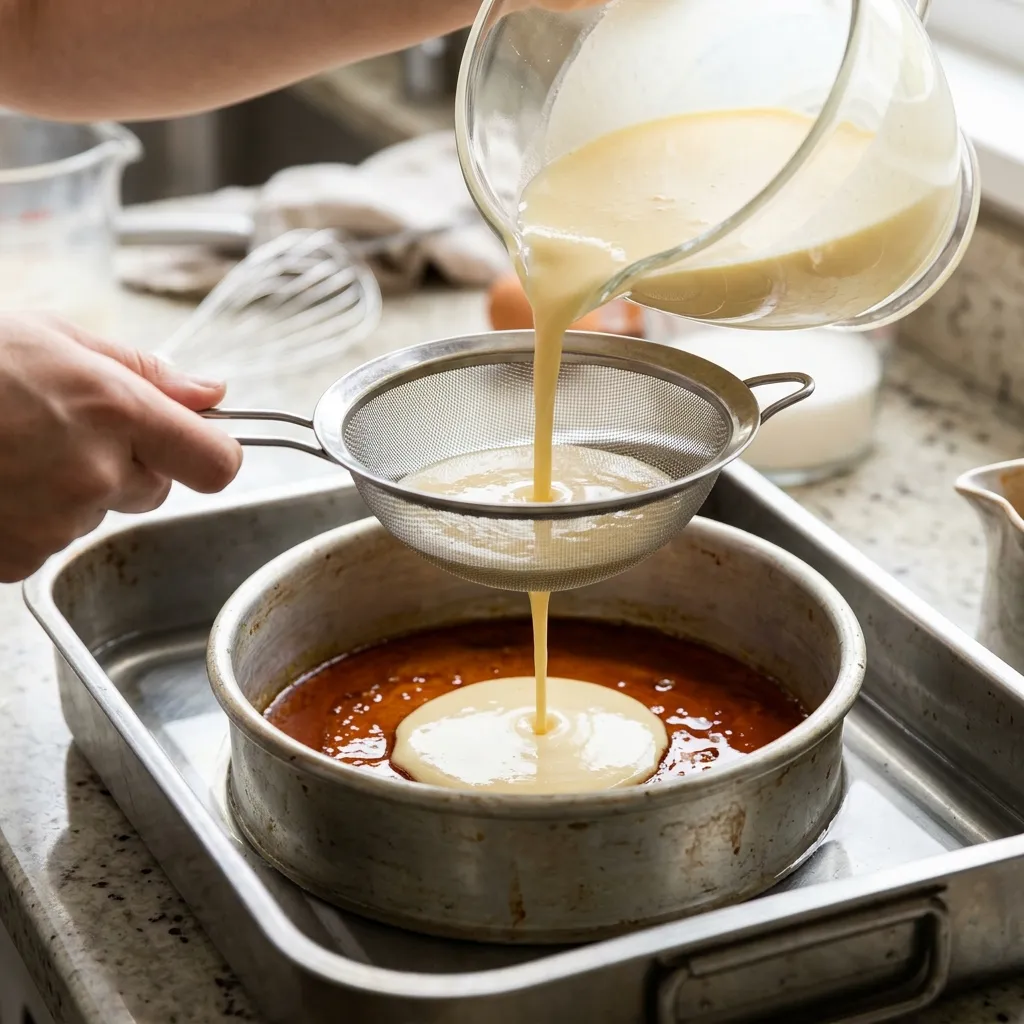
- Pour the custard through the strainer into a pitcher with a spout, then skim off any foam. The surface should look flat and glassy.
- Pull the center rack halfway out, set the roasting pan on it, and place the cake pan inside. Pour the custard over the hardened caramel, then pour hot water around the cake pan until it reaches halfway up the sides. The custard should sit level, with no water touching it.
- Cover the cake pan tightly with foil, slide the rack in, and bake 60 to 70 minutes. Chef’s Note: Check at 60 minutes by lifting one foil corner, because every oven runs a little different. The edges should look set while the center 2 inches still wobble like gelatin.
- Turn off the oven, leave the pan in the bath for 30 minutes, then lift it onto a wire rack with oven mitts. Remove the foil and cool 30 minutes more. The pan should feel barely warm, and the surface should look matte.
- Cover the cooled pan with plastic wrap and refrigerate at least 6 hours, or overnight. The center should feel firm, and the custard should pull slightly from the pan edge.
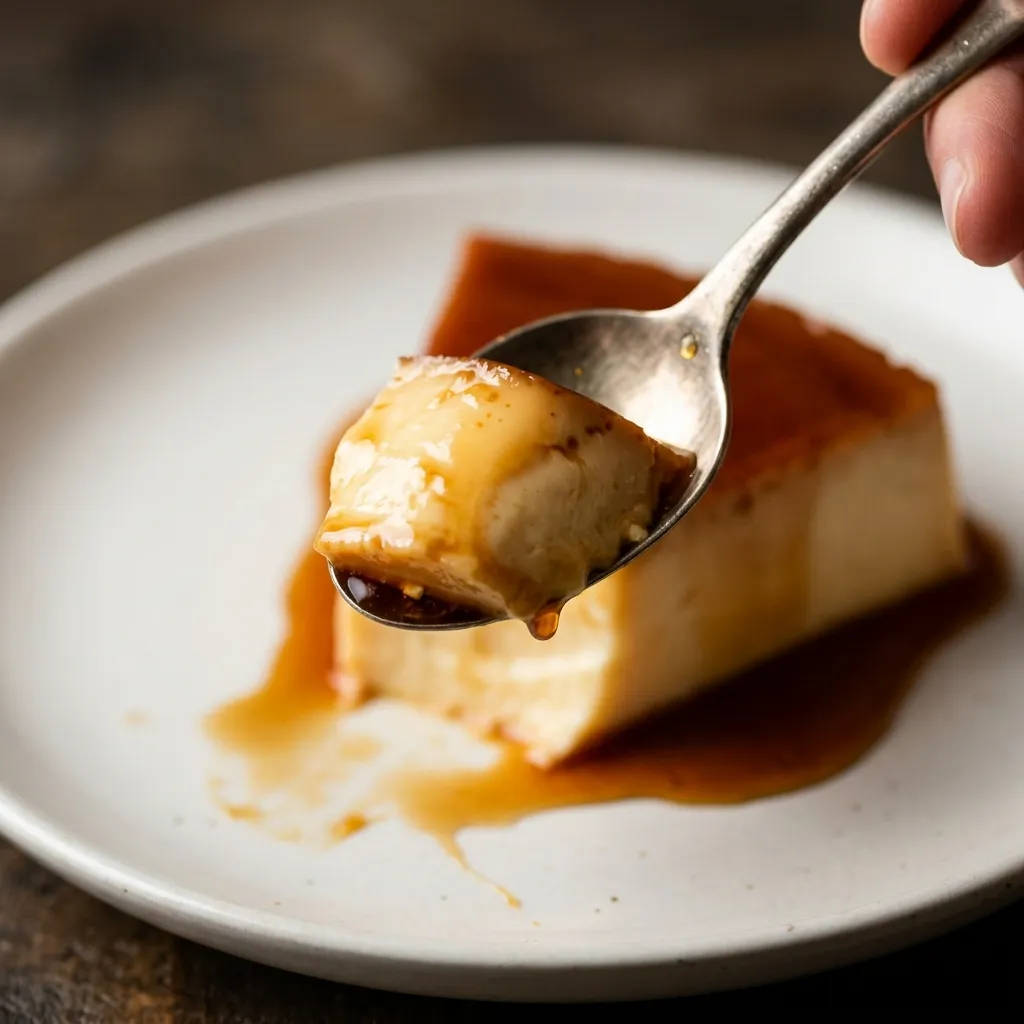
- Run a thin knife around the edge, then set the pan in 1 inch of hot tap water for 1 minute. Set a rimmed plate on top and flip both in one firm motion. Lift the pan after 10 seconds, and the flan should slump softly while caramel runs down the sides.
Expert Tips and Tricks
- I cut the chill to 3 hours once for a Friday dinner, and the center slumped into a puddle on the plate. Six hours is the minimum.
- Bake it up to 2 days ahead and keep it covered in the pan.
- Use full-fat dairy. Reduced-fat evaporated milk made my middle watery.
- Peek at the water bath once around the 30 minute mark. If it bubbles, drop the oven to 300°F, because boiling water toughens the edges.
- Fill the hot caramel saucepan with water right after pouring, and the leftover caramel dissolves in minutes.
- Keep leftover flan covered in the fridge for up to 4 days.
Common Mistakes and Troubleshooting
Tiny holes or a spongy slice. Air whipped into the custard expands in the oven, and a hot bath makes it worse. Whisk gently, strain, and hold the oven at 325°F. Baked holes cannot be fixed, but sauce hides them.
A watery center after chilling. The custard was underbaked or flipped too soon. Bake until the center 2 inches wobble like gelatin, then chill 6 hours. If it is still loose in the pan, bake 10 more minutes in the bath.
Gritty or bitter caramel. Stirring after the sugar dissolves, or sugar stuck on the pan wall, creates crystals, and a dark brown color tastes bitter. Swirl instead of stirring, and pull the pan at copper. For crystals, add 2 tablespoons of water and reheat.
Rubbery edges or cracks. Too much heat tightens the eggs. Check at 60 minutes and keep the bath below a boil. Eggs turn tough over high heat in any custard, including the stovetop kind in banana pudding with silky homemade custard.
Storage Instructions
- Room Temperature: Not recommended. Leave it out no longer than 2 hours, or 1 hour above 90°F.
- Refrigerator: Keep flan in the pan under plastic wrap, or move slices to an airtight glass container. It stays good for 4 days.
- Freezer: Not recommended, because thawed custard turns watery and grainy. If you must, wrap single slices in plastic, seal them in a freezer-safe zip bag, freeze up to 1 month, and thaw overnight.
- Reheating: Flan is served cold, so skip the microwave. Let a slice sit at room temperature 15 minutes to take off the chill.
- Make-Ahead Notes: Bake and chill up to 2 days ahead, and flip it only when you are ready to serve.
I store leftover slices on a rimmed plate under an upside-down bowl, because plastic wrap sticks to the soft top and tears it. The slices stayed smooth for all 4 days in my tests.
Storage Trick: Pour leftover caramel from the plate into a small jar and refrigerate it. Warm the jar in hot water for 10 seconds, then spoon the sauce over a cold slice the next day.
Variations and Substitutions
Spicy Cinnamon Flan: Whisk 1 teaspoon ground cinnamon and 1/8 teaspoon cayenne pepper into the custard. The cayenne adds slow warmth without tasting hot. Bake time stays the same.
Kid-Friendly Mini Cups: Divide the caramel and custard among eight 6-ounce ramekins and bake 35 to 45 minutes at 325°F, until the centers wobble gently. Kids can flip their own, and you skip the slicing.
Vegetarian and Gluten-Free: This recipe is already both, since it uses only sugar, eggs, dairy, vanilla, and salt. Check labels if you cook for celiac disease.
Coconut Version: Replace the whole milk with 1 cup of full-fat coconut milk for a gentle coconut taste. Light coconut milk makes the custard set too soft.
Coffee Version: Dissolve 2 teaspoons instant espresso powder in 1 tablespoon hot water, then whisk it into the custard.
What to Serve With This
- Chicken enchiladas: Serve a small square after chicken enchiladas. The cool, sweet custard calms the chili heat.
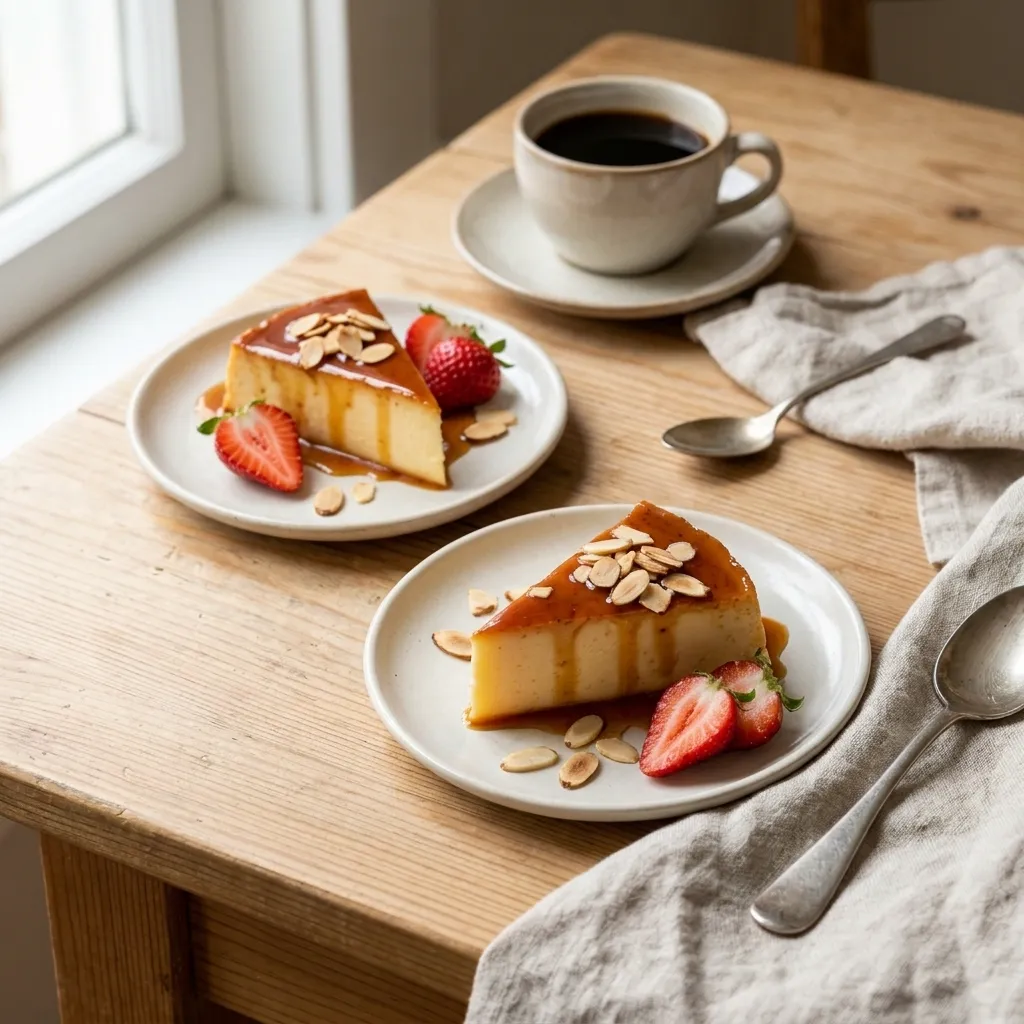
- Fresh strawberries: Sliced berries add tartness that cuts through the richness.
- Toasted sliced almonds: Toast 2 tablespoons in a dry skillet for 3 minutes and scatter them on top for crunch.
- Hot coffee or cold milk: Both balance the sweetness.
- A Latin dessert table: Set out small bowls of arroz con leche beside the custard, so guests can compare rice and silk.
Frequently Asked Questions
Can you make flan the day before?
Yes, and you should. Flan needs at least 6 hours in the fridge, and an overnight chill gives you the firmest slice and a caramel that has fully melted into sauce. Bake it up to 2 days ahead, keep it covered in the pan, and flip it within the hour before you serve. I bake mine the night before a dinner and flip it while the coffee brews.
Why won’t my flan come out of the pan?
The caramel has hardened and glued it down. Run a thin knife around the edge, then set the pan in 1 inch of hot tap water for 1 minute to soften the caramel. Flip it onto a rimmed plate and wait 10 seconds before lifting the pan. Never pry at it with a fork, which tears the sides. A pan with straight, smooth walls also helps, because ridged pans trap the custard.
Can I make flan without sweetened condensed milk?
Yes, but it becomes a different recipe called crème caramel, so you cannot swap it one for one here. Condensed milk supplies the sugar, the body, and the thick texture, and removing it throws off the whole ratio. For the lighter classic, follow a crème caramel recipe that sweetens plain milk and cream with sugar instead. It tastes lighter than the condensed milk version.
How do you know when flan is done?
Look for set edges and a center that wobbles like gelatin in a circle about 2 inches wide. If the whole surface ripples like liquid, bake 5 more minutes. An instant-read thermometer in the center should read at least 160°F, the USDA minimum for egg dishes. The flan keeps setting as it chills, so do not wait for a firm center.
Why does my flan taste eggy?
Overbaking is the usual cause, because overheated egg proteins release a sulfur smell and taste. Pull the pan while the center still wobbles, and keep the water bath below a boil. Weak flavoring also lets egg show through, so use the full tablespoon of alcohol-free vanilla and the pinch of salt. A teaspoon of orange zest whisked into the custard also brightens the flavor.
Final Thoughts Before You Bake
Nine batches taught me that patience beats technique. Gentle heat, a gentle whisk, and a long chill do more than any fancy tool. The last test went to my daughter, who asked for it three days in a row and ate the final slice standing at the fridge at 7 a.m. before school.
If you remember one thing about making flan, make it the wobble: pull the pan while the center still shakes, and the fridge finishes the job. Bake it after dinner tonight and serve it tomorrow.
If you loved this recipe, save it to your dessert Pinterest board so you can find it easily later!
Easy Flan Recipe with Silky Caramel Custard That Slices Clean
Ingredients
Equipment
Method
- Heat the oven to 325°F with a rack in the center. Take the eggs out of the fridge 30 minutes ahead, boil 6 cups of water, and leave the 9-inch cake pan dry and ungreased.
- Stir the sugar and water in the saucepan over medium heat until the sugar dissolves, then stop stirring. Swirl the pan if one side darkens faster, and cook 8 to 10 minutes until the syrup looks like an old copper penny.
- Pour the hot caramel into the cake pan and tilt to coat the bottom within 30 seconds, until it stops moving and looks glossy amber.
- Whisk the eggs for 30 seconds, then add the condensed milk, evaporated milk, whole milk, vanilla, and salt. Keep the whisk low and mix for 1 minute until the custard looks smooth, pale yellow, and nearly foam free.
- Pour the custard through the strainer into a pitcher with a spout, then skim off any foam until the surface looks flat and glassy.
- Pull the center rack halfway out, set the roasting pan on it, and place the cake pan inside. Pour the custard over the hardened caramel, then pour hot water around the cake pan until it reaches halfway up the sides, so the custard sits level with no water touching it.
- Cover the cake pan tightly with foil, slide the rack in, and bake 60 to 70 minutes. Check at 60 minutes by lifting one foil corner: the edges should look set while the center 2 inches still wobble like gelatin.
- Turn off the oven, leave the pan in the bath for 30 minutes, then lift it onto a wire rack with oven mitts. Remove the foil and cool 30 minutes more until the pan feels barely warm and the surface looks matte.
- Cover the cooled pan with plastic wrap and refrigerate at least 6 hours, or overnight, until the center feels firm and the custard pulls slightly from the pan edge.
- Run a thin knife around the edge, then set the pan in 1 inch of hot tap water for 1 minute. Set a rimmed plate on top and flip both in one firm motion, then lift the pan after 10 seconds, when the flan slumps softly and caramel runs down the sides.
Notes
- Use full-fat milks and keep the whisk low in the bowl, because extra air turns into holes in the baked custard.
- Keep the oven at 325°F and the water bath below a boil to avoid rubbery edges.
- Storage: Refrigerate covered for up to 4 days. Freezing is not recommended, but wrapped slices keep up to 1 month.